News Overview
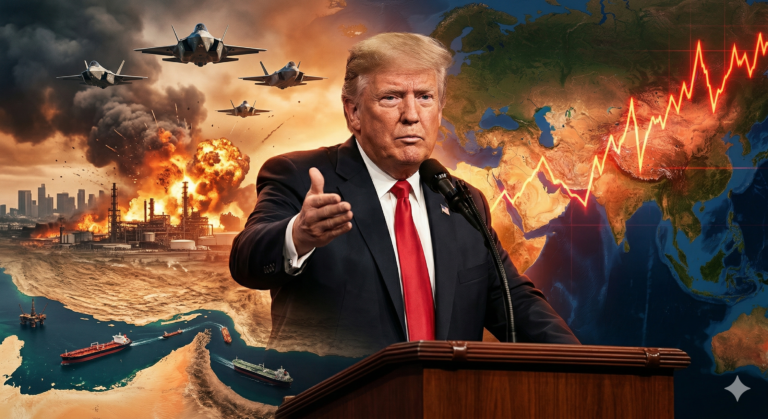
On February 17, U.S. President Donald Trump announced that Japan will invest $36 billion in U.S. energy and industrial projects. The announcement represents the first tranche of concrete projects under the broader “$550 billion investment framework” associated with the recent U.S.-Japan trade deal.
The investment targets three facilities: a natural gas power plant in Ohio, a deepwater crude oil export terminal in Texas, and a synthetic industrial diamond manufacturing facility in Georgia. U.S. Secretary of Commerce Howard Lutnick said the Ohio facility alone is expected to generate 9.2 gigawatts of power, which President Trump described as “the largest in history.”
Japanese Prime Minister Sanae Takaichi said the projects were designed to strengthen supply chain resilience and cooperation in key economic security areas, including energy, critical resources, and artificial intelligence. Under the agreement, once a project is selected, Japan is reportedly required to disburse funds within 45 business days.
Source: Reuters
Deep Dive: The Mechanics of Trump’s Tariffs and Japan’s Investment Framework
Why is Japan committing this money?
The starting point is the Trump administration’s tariff strategy. President Trump has repeatedly used the threat of higher tariffs against trading partners, including Japan, with the stated goal of reducing the U.S. trade deficit and forcing manufacturing back to American soil.
For Japan, high tariffs on key exports such as automobiles would be economically damaging. As a result, Japan pursued a deal that aligns both sides’ priorities:
- U.S. goal: attract factories, jobs, and large-scale capital into the United States.
- Japan’s goal: reduce tariff risk and prevent deterioration of the trade environment.
The broader framework is valued at $550 billion. The newly announced $36 billion is the first set of projects publicly identified under that framework.
Clarification: The $550 Billion is Not a Cash Handout
A common misconception is that Japan is simply handing over hundreds of billions of dollars in tax revenue to the U.S. government. This is not how the framework is designed.
Instead, it channels funding into U.S. projects through a combination of instruments:
- Loans: financing provided by Japanese public institutions (such as JBIC).
- Equity: Japanese corporations participating through investment and ownership.
- Guarantees: public underwriting if funds cannot be recovered.
In practical terms, Japan is creating a mechanism to prioritize funding for large-scale U.S. projects. The U.S. gains infrastructure and jobs, while Japan reduces tariff risk and strengthens its access to energy and critical supply chains.
Breakdown of the First $36 Billion Tranche
The three projects announced by President Trump are not random. Each one reinforces a key pillar of U.S. industrial strategy.
1. Power: The Massive Gas Plant in Ohio ($33 Billion)
The centerpiece of the tranche is a major natural gas power facility in Ohio, reportedly involving SoftBank-linked entities. The U.S. is facing rapidly rising electricity demand driven by AI development, data centers, and manufacturing reshoring.
Without sufficient power, the U.S. cannot scale its next-generation industrial and AI infrastructure. This investment directly supports that foundation.
2. Oil: Deepwater Export Terminal in Texas ($2.1 Billion)
Referred to as “GulfLink,” this project addresses export bottlenecks. While the U.S. is a major oil producer, port and terminal capacity can limit export flows. Strengthening these facilities reinforces the U.S. role as a global energy exporter.
3. Materials: Industrial Diamond Factory in Georgia ($0.6 Billion)
Though smaller in dollar terms, this facility is strategically meaningful. Industrial synthetic diamonds are used in advanced manufacturing processes, including those tied to high-end technology supply chains. The investment aligns with broader U.S. efforts to reduce dependency on China in critical industrial inputs.
Strategic Analysis
A Survival Strategy for the “Era of Tariffs”
This deal may look distorted from the perspective of free trade ideals. But it reflects a pragmatic adaptation by Japan. If tariffs remain a core U.S. negotiating tool, Japan’s export-driven economy has limited options.
Rather than colliding head-on, Japan is supplying “political wins” through investment that can be framed domestically as job creation and industrial revival.
Embedding into the U.S. Infrastructure Core
Japan is doing more than paying a toll. By committing capital to power generation and energy export infrastructure, Japan is embedding itself into the foundation of America’s next-generation economy.
This deepens structural interdependence. In theory, the more U.S. industrial expansion relies on projects tied to Japanese financing, the harder it becomes for Washington to treat Japan as a disposable partner.
The Invisible Risks for Japan
However, risks remain. Public financing is involved, meaning failed projects could translate into losses ultimately absorbed by Japanese institutions. There is also an opportunity cost: funds directed toward U.S. infrastructure are not directed toward Japan’s own aging infrastructure, energy resilience, or domestic AI capacity.
Finally, the greatest uncertainty is political risk. There is no guarantee that tariff relief will remain stable over time. Japan will need strict contracts and continued diplomatic leverage to ensure the deal holds.
Conclusion: Deepening Strategic Interdependence
This $36 billion tranche signals a deeper shift toward strategic interdependence between Japan and the United States. Japan is moving into the U.S. industrial core to reduce tariff risk, while the U.S. is rebuilding key infrastructure with Japanese capital.
Whether this is ultimately seen as a brilliant survival strategy or a costly concession will depend on execution, project viability, and the stability of future trade negotiations.
References
Trump says Japan to invest in energy, industrial projects in Ohio, Texas and Georgia (Reuters)
Japan to accelerate talks with US on first deals under trade package (Reuters)
US and Japan unveil first mega-projects under $550bn deal (Financial Times)