Key Points
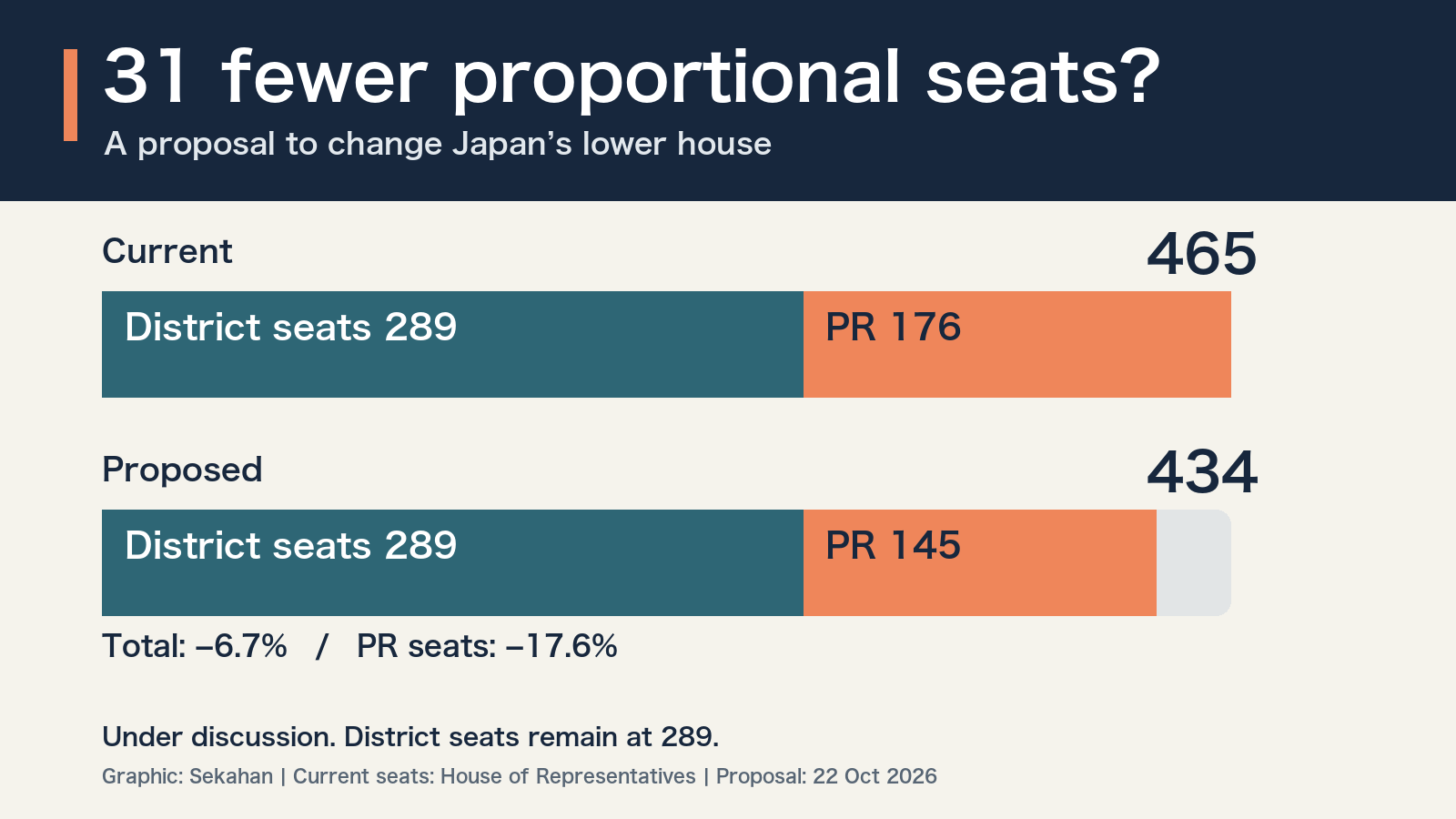
・On October 22, 2026, the Liberal Democratic Party (LDP) proposed in working-level talks among parties to cut the House of Representatives’ proportional seats by 31, from 176 to 145, and to pair the cut with a new allocation formula and a stricter revival rule, according to FNN on October 23.
・Japan’s lower house is elected under a parallel system of 289 single-member districts and 176 proportional seats, and the proposal touches three separate levers: how many seats, how they are divided, and which defeated district candidates can still win a proportional seat.
・The cut size, the allocation formula and the revival threshold act differently on each party and candidate, so the talks decide not only how many lawmakers there are but whose support turns into seats.
▼ Watch the Japanese-language video explainer
This video has Japanese audio and slides. To read English captions, open Settings → Subtitles/CC → Auto-translate → English, where available. Automatic translations may contain errors. If the option is unavailable in the embedded player, watch on YouTube. The accompanying English article provides the written explanation.
LDP Proposes a 31-Seat Proportional Cut as a Compromise
On October 22, 2026, the LDP presented a plan in working-level talks among ruling and opposition parties to reduce the House of Representatives’ proportional seats by 31, according to FNN on October 23. The figure is smaller than the 45-seat cut in the bill that the LDP and the Japan Innovation Party (Ishin) submitted in June 2026, and the 31 is said to be based on a 6.7 percent population decline between 2015 and 2030, according to a Jiji Press report of October 22.
The plan also changes the formula for dividing proportional seats from the current D’Hondt method to a modified Sainte-Laguë method, and it tightens the conditions for “proportional revival,” under which a candidate who loses a single-member district can still win a seat through the proportional list, according to FNN.
Motohisa Furukawa of the Democratic Party for the People (DPFP) gave the plan some credit as one that took in many of his party’s views and said it would be considered inside the party, according to ANN on October 23. Ishin’s Ryuna Kanamura said Ishin had argued for a 45-seat cut and would consider the plan in light of that, according to FNN.
Komeito’s policy chief Hiromasa Nakano opposed cutting only proportional seats because it would unbalance the system, and Takayuki Ochiai, policy chief of the Democratic Reform Council, said the plan should be judged together with a fundamental overhaul, according to ANN on October 23. Team Mirai said it could not see why all 31 should come out of the proportional tier, according to the same report.
Each party will take the plan home and state its position at the following week’s talks, and the aim is to conclude by the end of October, according to ANN and FNN. This is still a proposal. It has not been agreed by the parties or enacted.
Related Articles
Two Votes, Eleven Blocks, and How Revival Works
What “proportional revival” is, and where the 31 comes from
“Proportional revival” (hirei fukkatsu) refers to the way a candidate who loses a single-member district in Japan’s lower house can still take office through the party’s proportional list, if the party wins enough proportional seats in that region. Voters cast two ballots, one for a candidate in a single-member district and one for a party in a regional proportional block.
The House of Representatives has 465 seats, made up of 289 single-member districts and 176 proportional seats, according to the House of Representatives. The 176 are divided among 11 regional blocks of 6 to 28 seats each, according to the Aomori Prefecture election commission page updated in January 2026. Because the two tiers are elected separately, in what is called a parallel (mixed-member majoritarian) system, changing the proportional formula does not correct the gap between votes and seats produced in the districts, because Article 95-2 of the Public Offices Election Act allocates proportional seats from party-list votes alone.
Taking all 31 from the proportional tier would give the following, by our calculation from the House of Representatives’ seat figures:
| Item | Current | 31-seat cut (proportional only) |
|---|---|---|
| Total seats | 465 | 434 |
| Single-member districts | 289 | 289 |
| Proportional seats | 176 | 145 |
| Proportional share of seats | about 38% | about 33% |
The cut is about 6.7 percent of all seats and about 17.6 percent of the proportional tier. Smaller blocks make it harder for a party to reach its last seat, so which blocks lose seats matters, and that distribution has not been reported.
The cut has a history. The LDP and Ishin agreed in their coalition deal of October 2025 to aim for a 10 percent reduction in lower house seats, and in June 2026 they submitted a bill to cut 45 proportional seats, according to the LDP’s June 11 announcement and a June 14 report by the Japanese Communist Party’s newspaper Akahata. The bill would have triggered the cut automatically if no conclusion were reached within one year after the law took effect, according to Akahata, and it has not been enacted. The LDP’s stated reason for trimming only the proportional tier is that cutting districts would reduce rural representation further and split urban districts more finely, and that an electoral system should emphasize aggregating public will, according to the LDP’s June 11 announcement. The 6.7 percent figure relies on a 2030 population projection and is the proposers’ calculation, according to the Jiji Press report.
D’Hondt versus Sainte-Laguë, in a fictional example
Both formulas divide seats using a series of divisors. D’Hondt divides each party’s votes by 1, 2, 3 and so on and awards seats to the highest quotients. Sainte-Laguë divides by 1, 3, 5, which makes each additional seat harder for a large party to win.
Take a fictional block with five seats where Party A wins 61 votes, Party B 25 and Party C 14:
| Method | Party A | Party B | Party C |
|---|---|---|---|
| D’Hondt (divide by 1, 2, 3…) | 4 | 1 | 0 |
| Sainte-Laguë (divide by 1, 3, 5…) | 3 | 1 | 1 |
This example is fictional and illustrates only how remainders are treated. It is not a projection for Japan.
A modified Sainte-Laguë method raises the first divisor above 1, which makes a party’s first seat harder to win. A National Diet Library survey cites Sweden’s first divisor of 1.4, lowered to 1.2 in 2014. Japan’s first divisor has not been reported, so it should not be assumed to be 1.4. Team Mirai has long proposed the standard version starting at 1, according to the party’s proposal page.
How the revival order works
Under the Public Offices Election Act, a candidate may run in a district and on the proportional list at the same time, which is called dual candidacy. Seats are settled in three steps: the party’s proportional vote decides how many seats it wins in a block, the list order decides who fills them, and among dual candidates ranked equally on the list, the one with the higher “sekihairitsu” (the narrow-loss rate) is chosen first.
The narrow-loss rate is a candidate’s district votes divided by the votes of the winner in that district. It is used to compare candidates ranked at the same position on the list, not to rank all candidates nationwide.
There is also an eligibility line. Under the current law, a dual candidate who wins less than one tenth of the valid votes in the district is treated as not being on the list, according to Article 95-2 of the Public Offices Election Act, and that line matches the one at which election deposits are forfeited. On October 20, LDP lawmaker Junji Hasegawa argued the line should be raised to at least one sixth, according to ANN on October 20. One sixth is the minimum share needed to win a district, according to Article 95 of the same Act.
Take a district with 100,000 valid votes. A candidate with 12,000 votes meets the current line of 10,000 but would fall short of the roughly 16,667 votes a one-sixth rule would need, by our calculation. Meeting the line does not guarantee a seat, because the party’s seat count and list order still apply. Candidates who appear only on the proportional list are not subject to this district-vote line, according to the Act.
Who the 31 Is Designed For, and Who Pays
Does 31 aim to satisfy both Ishin and the DPFP?
The 31 appears designed to keep Ishin’s promise of a cut alive while winning DPFP support, according to Jiji Press on October 22. The DPFP has long argued that the number of lawmakers should follow population, and the LDP is reported to be using that measure to win its vote.
Ishin co-leader Fumitake Fujita said on October 21 that only about 30 percent of the coalition’s policies had been realized and called passing the 45-seat bill “the proper path,” according to ANN on October 21. For Ishin, 31 is a step back from the 10 percent goal in the coalition deal. At the same time, the 45-seat bill has not found enough opposition support to pass. Reading 31 as a figure that tries to satisfy both a promised result and a number the DPFP can accept is one reasonable interpretation. The DPFP has only expressed some credit so far, and its formal position may change with the formula and the revival rule.
Why parties that rely on proportional seats do not react alike
Parties that depend on proportional seats do not share one view. Among lower house caucus members as of September 28, all 15 Sanseito members, all 11 Team Mirai members and all 4 Japanese Communist Party (JCP) members were elected through the proportional tier, according to the House of Representatives’ caucus rosters.
The JCP opposes any reduction, arguing that fewer representatives weaken oversight of the government, according to Akahata. Team Mirai opposes cutting proportional seats while proposing the standard Sainte-Laguë formula, and adopting its formula suggestion would not by itself mean it backs a package that also includes the cut. Sanseito’s October 14 official report called for careful debate, citing the low number of lawmakers per capita and the way proportional seats carry diverse views, but that statement came before the October 22 proposal.
Where the winners sit differs too. Team Mirai’s 11 are concentrated in the Tokyo block (4) and the Minami-Kanto block (3), while the JCP’s 4 are spread one each across four blocks, according to the same rosters. Komeito and the Democratic Reform Council form a joint lower house caucus called “Chudo.” Komeito asked on October 11 that any cut be split between district and proportional seats at a 3 to 2 ratio, and the Democratic Reform Council’s secretary-general Takeshi Shina said on October 13 that it would align with Komeito on proportional cuts. A group with district seats and a party that built its seats through proportional lists weigh the system differently.
Inochi no To (formerly Reiwa Shinsengumi), with one lower house member, and the Social Democratic Party (SDP), with none, see the proportional tier as an entry point. The SDP opposed seat cuts in an October 6 statement. These earlier statements predate the October 22 plan and should be read as prior positions.
Why a smaller tier and a new formula pull together, and why the net effect is unknown
The change to a modified Sainte-Laguë formula leans toward smaller parties, while a smaller proportional tier pulls against them, and the two operate at the same time. With 145 seats instead of 176, each block has fewer seats and the share of votes needed for one seat rises. Which effect is larger depends on the party and the block, and a party-by-party total cannot yet be calculated.
For very small parties, the modified formula’s effect depends on the first divisor and block size, neither of which has been reported. Akahata reported on October 23 that the LDP showed seat projections under the modified formula and that JCP lawmaker Tetsuya Shiokawa criticized them as raising the ruling parties’ share. The figures and the conditions behind them were not published in that report, so they cannot be checked yet.
Should the revival rule be tightened?
Supporters of tightening argue about fairness: a candidate whom the local district did not widely back should not win a seat. Aligning the line with the one-sixth needed to win a district would also make it clearer that candidates must build support locally.
Those wary of it point out that proportional votes are a separate expression of will cast for a party. In a district where only one person wins, newcomers, specialists and candidates from small parties find it hard to win, and revival is also a path that sends such people to the Diet. Whether second place in a district means voters rejected a candidate is a matter of judgment.
A tighter rule would apply to every dual candidate regardless of party size, and within one party it would affect candidates with strong local votes differently from those with weak ones. If parties place weaker local candidates high on the list as list-only candidates, party leadership’s say over list order could grow, which is a possibility rather than something reported. Cutting seats, changing the formula and tightening revival are packaged together, and they weigh differently on each party and candidate.
Japanese Reactions to Japan’s 31-Seat Proportional Cut
This section covers five posts on X selected from widely shared Japanese posts about the plan. They are reactions on X, not a measure of Japanese public opinion. The most widely shared posts leaned against the cut, and supportive voices were fewer, so the selection below reflects that imbalance. Any numbers in the posts are the posters’ own claims. Each quote is a short translated excerpt.
JCP lawmaker Taku Yamazoe’s post had about 7,500 likes when we collected it.
自民党が比例定数31削減案を提示。「前回の定数見直し以降の人口減少分を反映」というが、直近で定数が減らされた2016年から現在まで人口減少は400万人あまり。定数180の比例議席を2割近くも削る道理はない。
— 山添 拓 (@pioneertaku84) October 22, 2026
人口比の議員数は国際的にはむしろ少ない。人口を理由にするなら逆に増やすべきだ。 https://t.co/gIDpq3XEnP
“There is no reason to cut the proportional tier of 180 seats by nearly 20 percent. If population is the reason, we should increase seats instead.”
Taku Yamazoe, Japanese Communist Party, October 22, 2026 (excerpt, translated)
He argued that population has fallen by only a little over 4 million since 2016, the last time seats were cut, and that Japan has relatively few lawmakers per capita. The current proportional tier has 176 seats, which differs from the “180” in his post.
Akira Koike of the JCP made a similar case.
日本の国会議員数はOECD38カ国で下から3番目と少ないのに、なぜ削減か。
— 小池 晃(日本共産党 Japanese Communist Party JCP) (@koike_akira) October 22, 2026
民意を最も正確に反映する制度なのに、なぜ比例だけの削減か。
国会議員は主権者である国民の代表であり、定数削減は国民の声を切り捨て、国会の政府監視機能を後退させる。
全く道理なし。 https://t.co/YinPIRiSzC
“Japan’s number of national lawmakers is third from the bottom among the 38 OECD countries. Why cut? Why only the proportional tier, the system that reflects public will most accurately?”
Akira Koike, Japanese Communist Party lawmaker, October 22, 2026 (excerpt, translated)
The OECD ranking is his claim. He added that the cut would weaken the Diet’s oversight of the government.
The first post from inside the governing camp raised a different question.
法案審議もせずにいきなり連立合意の公約を妥協するのだろうか。野党に打診する前に維新の了解をとるべきでは。
— 青柳仁士(衆議院議員) (@aoyagi_h) October 21, 2026
自民党、衆院定数31減を野党に打診 今国会実現へ協力探る:日本経済新聞 https://t.co/gsFKRj9wnb
“Are they really going to compromise on a coalition-agreement pledge without even debating the bill? Shouldn’t they get Ishin’s consent before approaching the opposition?”
Hitoshi Aoyagi, Ishin lower house member, October 22, 2026 (excerpt, translated)
His post cited a Nikkei report on the LDP’s approach to opposition parties, and it shows that unease about the 31 was not limited to opposition parties.
A former Ishin leader took the opposite view.
【速報】維新、定数31減案に反対せず #47NEWS https://t.co/abogZbddfR @47news_officialより
— 松井一郎 (@gogoichiro) October 22, 2026
高市政権発足当時は自民党は衆参両院で過半数を持たない中での連立合意、今年の選挙後は自民党単独で三分のニ圧倒的多数、自民党内でも定数削減に後ろ向きな人もいる状況だから、一歩前進は許容範囲やね。
“One step forward is within the acceptable range.”
Ichiro Matsui, former Ishin leader and former Osaka mayor, October 22, 2026 (excerpt, translated)
He cited a 47NEWS flash headline that Ishin did not oppose the 31-seat plan, and noted that the LDP now holds an overwhelming two-thirds majority on its own while some LDP members are reluctant to cut seats at all.
The last post is from an individual user who backed a deal.
個人的には、とりあえず比例31削減で野党と握れるなら握って、法案を可決すれば良い。
— ゆるふわ海原雄山 (@Mv65ZiLRGi6rCGU) October 21, 2026
かわりに維新は、次の国政選挙で、改めて45議席まで定数削減することを公約に掲げて戦えばいい。
連立を組む自民との差別化になるだろう。
https://t.co/EwxMAvJijU
“Personally, if they can strike a deal with the opposition on a 31-seat cut, they should do it and pass the bill. Ishin can campaign on 45 at the next election instead.”
Individual user, October 22, 2026 (excerpt, translated)
The post, which had about 176 likes when we collected it, frames 31 as a practical first step and 45 as a future campaign pledge. In these five posts, the opposition’s objection was about representation and oversight, while the supportive voices were about timing and negotiation.
What Gets Decided Beyond the Number
Counting rules, thresholds and who sets them
The talks over the 31-seat cut look like a debate about how many lawmakers Japan needs, and they are also a decision about whose support becomes seats and who finds it easier to run. The LDP and Ishin want a record of reduction, the DPFP is looking for a population-based compromise, and parties built on the proportional tier are watching both the formula and the number of remaining seats.
Supporters of cuts point to the cost of the Diet and the idea that politicians should bear some of the burden first. The workload of deliberation, oversight and listening to regional requests does not fall in proportion to population, so how to weigh cost against workload divides opinion. Because those who are elected also set the rules for elections, the reasons given for the number, whose views were heard and how the choice was explained become part of how the system is judged.
If the plan is agreed and enacted, including which election it first applies to, the combination of cut size, block seat counts, first divisor and revival rule will shape the candidates and parties voters can choose from.
Frequently Asked Questions
What is Japan’s 31-seat proportional cut proposal?
It is an October 22, 2026 LDP proposal to cut the House of Representatives’ proportional seats by 31, from 176 to 145, according to FNN on October 23. It also changes the allocation formula from D’Hondt to a modified Sainte-Laguë method and tightens proportional revival, and it has not been agreed or enacted.
What does the revival threshold change?
Under the current Public Offices Election Act, a dual candidate who wins less than one tenth of the valid votes in a district is treated as not on the proportional list, and LDP lawmaker Junji Hasegawa called on October 20 to raise that to at least one sixth, according to ANN. In a district with 100,000 valid votes, a candidate with 12,000 would pass the current line but not a one-sixth line, by our calculation.
Is the first divisor of the modified Sainte-Laguë formula known?
No, the first divisor in Japan’s plan had not been reported as of October 23, 2026, according to the news reports and the Akahata article cited here. A National Diet Library survey notes that Sweden used 1.4 and lowered it to 1.2 in 2014, but that is not evidence of Japan’s figure.
How did Japanese social media react to the 31-seat proportional cut?
Among the five widely shared posts on X that we selected, two Japanese Communist Party lawmakers opposed the cut on October 22, 2026 citing representation and oversight, an Ishin lawmaker questioned the compromise, and a former Ishin leader and an individual user accepted it as a practical step. This is a selection from X, not a measure of Japanese public opinion, and widely shared posts leaned against the cut.
Sekahan on YouTube
We publish video summaries of articles like this one, along with short clips built around Japanese reactions.
Reference Links
- LDP proposes cutting 31 proportional seats, a new proposal on lower house electoral reform (in Japanese) | FNN Prime Online
- Proportional-only 31-seat cut proposed by LDP; Ishin holds to 10 percent cut, DPFP gives credit (in Japanese) | Nagoya TV (ANN)
- Tightening proportional revival: LDP plan stirs debate (in Japanese) | Nagoya TV (ANN)
- One year of coalition: Ishin’s Fujita says 30 percent of policies realized, checks LDP on seat cuts (in Japanese) | Nagoya TV (ANN)
- LDP’s 31-seat proportional cut plan; Shiokawa voices opposition (in Japanese) | Shimbun Akahata
- Electoral system reform and seat reduction bills approved by LDP committees (in Japanese) | Liberal Democratic Party
- Public Offices Election Act (in Japanese) | e-Gov Law Search
- Lower house electoral systems in other countries (in Japanese) | National Diet Library
- Caucus rosters (in Japanese) | House of Representatives