Key Points
・Ukraine announced on November 23, 2026 that it had attacked the Russian corvette Merkury in the eastern Libyan port of Benghazi the day before.
・The eastern forces that control the port cooperate with Russia, yet both of Libya’s rival governments condemned the strike as a violation of Libyan sovereignty.
・Whether a Russian warship is a lawful target and whether it may be attacked in a third country’s port are separate questions, and the second one now confronts Libya and neighboring Italy.
Ukraine Says It Struck a Russian Warship in Benghazi; Libya Calls It a Breach of Sovereignty
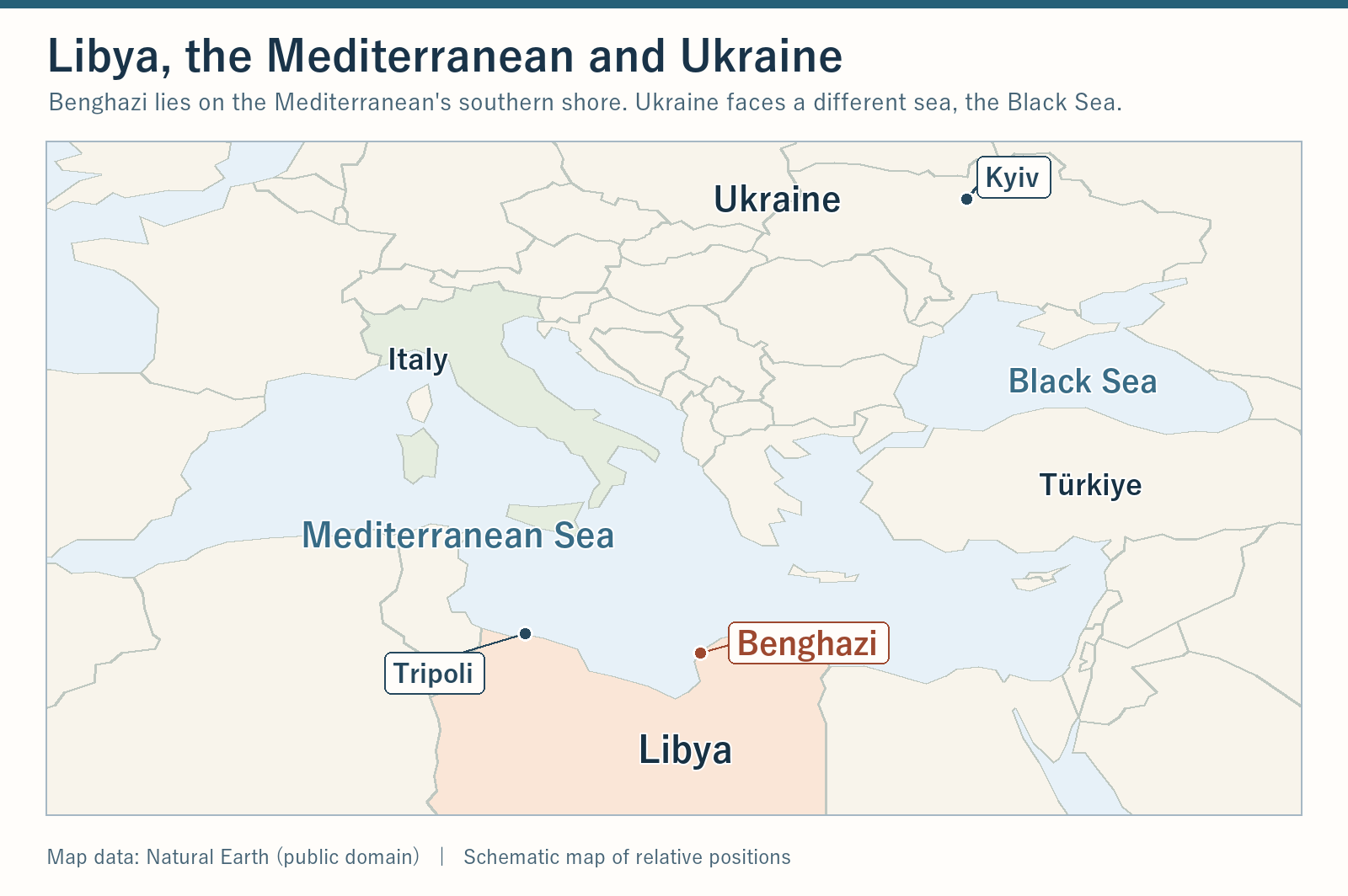
The Russian navy corvette Merkury exploded and caught fire while docked in the port of Benghazi, in eastern Libya, in the early hours of November 22, 2026. The eastern government said the ship had called at the port to take on fuel and supplies under a “cooperation agreement with Russia.” It said a drone attack was suspected and condemned the incident as a violation of sovereignty.
Satellite imagery from the US company Vantor, reported by AP, showed the ship almost capsized inside the port with only its bow above the water. As of November 24, Russia had not officially acknowledged the loss of the ship.
On November 23, President Volodymyr Zelenskyy said in a post on X that the operation was Ukrainian and that Merkury had been “sunk.” A cargo vessel offshore was also reported hit, but reports differ on its name and the extent of the damage.
On November 24, Ukrainian Foreign Minister Andrii Sybiha called the operation “legitimate self-defense” under Article 51 of the UN Charter and said Ukraine respects Libya’s sovereignty. The same day, the Libyan National Army, the military force in the east, announced that two of its servicemen who had been injured had died.
The UN-recognized Government of National Unity in Tripoli, in the west, condemned foreign military operations on Libyan territory and asked Ukraine for an official explanation. The UN Support Mission in Libya called for an independent investigation. Italian Foreign Minister Antonio Tajani told Sybiha that Italy would keep supporting Ukraine’s defense, and conveyed his concern about the war spreading to the Mediterranean.
Related Articles
Why a Russian Warship Was in Libya
The eastern government’s account: a “cooperation agreement”
The Libyan National Army (LNA) is the armed force led by Khalifa Haftar that controls eastern Libya, including Benghazi; it is separate from the UN-recognized government in Tripoli. The most direct account of why Merkury was in Benghazi comes from the eastern government allied with the LNA. It said the ship had called to take on fuel and supplies under a cooperation agreement with Russia. The terms of that agreement have not been published.
Behind this lies the situation of the Russian navy in the Mediterranean. Turkey controls passage through the Bosporus and Dardanelles straits, which link the Black Sea and the Mediterranean, under the 1936 Montreux Convention. At the end of February 2022, Turkey said it would apply the convention to restrict the passage of warships.
For Russian ships operating in the Mediterranean, the main supply base had been the Syrian port of Tartus. After the Assad government fell in December 2024, the future of Russia’s Syrian bases became uncertain, and Russia has been reported to be rearranging its footholds in the Mediterranean. Merkury’s own mission has not been disclosed.
Libya has two governments
After the Gaddafi government fell in 2011, Libya split into rival eastern and western camps from around 2014.
In the capital, Tripoli, in the west, sits the UN-recognized Government of National Unity under Prime Minister Abdul Hamid Dbeibah. In the east there is a separate government, while real military power lies with the LNA led by Khalifa Haftar. A ceasefire was agreed in 2020, but elections meant to reunify the country have been repeatedly postponed.
The government that represents Libya internationally and the force that actually controls the port of Benghazi are different bodies. The strike happened in the eastern port, and both the east and the west condemned it, each from its own position.
Haftar and Russia: from Wagner to the Africa Corps
Ties between the eastern forces and Russia go back to the civil war. From around 2018, personnel of the Russian private military company Wagner operated on the eastern side. After Wagner’s 2023 mutiny and the death of its founder, the Russian Defense Ministry’s “Africa Corps” is said to have taken over that role.
There have been reports of upgrades at air bases in the east and center of the country and of Russian ships calling at the eastern port of Tobruk. Some analysts describe Libya as a transit point through which Russia moves personnel and supplies to African countries further south, such as those in the Sahel.
The supply call described by the eastern government rests on a relationship in which the eastern forces have opened their ports to Russian ships and cargo. Jalel Harchaoui, a researcher on Libya, has said that Russia had been moving large amounts of equipment through Libyan ports, with Russian navy ships escorting them.
“The Russians were getting comfortable pouring thousands of tons of equipment through Libyan ports, with Russian navy escorts.”
— Jalel Harchaoui جلال حرشاوي (@JMJalel_H) November 23, 2026
I told The Wall Street Journal that the presence of the Russian Armed Forces was what drew the Ukrainian operatives to attack Benghazi.… pic.twitter.com/dhlCIh2Li8
Sovereignty, seen from Libya
The east, which has cooperated with Russia, and the UN-recognized west both say Libya’s sovereignty was violated, for different reasons.
The eastern government saw a partner’s ship struck in its own port. It opened a joint investigation with Russia and sent letters to the UN Secretary-General and the Security Council. The LNA, which announced the deaths of two servicemen, said it would respond “at the appropriate time and place.”
The western Government of National Unity asked Ukraine to explain the nature and scope of the operation. It also warned that foreign forces using ports or facilities outside the authority of the state is itself a security threat. On November 24, it called claims of an understanding with Ukraine over the strike baseless.
There are reports of Ukrainian personnel in western Libya, but the Government of National Unity has denied providing bases or similar support, and the reports have not been confirmed. The UN mission said in a statement that Libya cannot afford, and must not become, a battleground for foreign conflicts, and called for establishing the facts and for restraint.
UNSMIL expresses serious concern over the attacks carried out at Benghazi Seaport and off the city’s coast on Sunday, and stresses that Libya’s sovereignty, territorial integrity and the security of its citizens and assets must be fully respected.
— UNSMIL (@UNSMILibya) November 22, 2026
UNSMIL calls for an immediate,… pic.twitter.com/m8cmk7zmDv
Two questions: is the warship a target, and is this the place?
The debate over the strike covers two separate questions: whether a Russian warship is a lawful target, and whether it may be attacked in a third country’s port.
On the first, international humanitarian law, which governs the conduct of war, treats the warships of an enemy state in an armed conflict as military objectives in principle. In the sources we checked, we found no expert view that directly disputes this. How harm to people around the ship, such as port workers, was avoided is still a question for each attack.
On the place, Article 2(4) of the UN Charter prohibits the use of force against the territorial integrity of any state. Article 51 recognizes the right of self-defense for a state that suffers an armed attack and requires the measures taken to be reported immediately to the Security Council.
Ukraine’s claim of self-defense is directed at Russia, which continues its invasion. Some commentators point out that this claim does not by itself cancel the territorial integrity of a different state, Libya. The International Court of Justice’s 1949 judgment in the Corfu Channel case, which found that military action carried out in another state’s waters without consent violated its sovereignty, is also cited in this context.
There are also rules on the responsibility of the state that hosts a ship. The 1907 Hague Convention XIII limits, in principle, a belligerent warship’s stay in a neutral port to 24 hours and caps the supplies it may take on. We could not confirm whether Libya is a party to this convention. Because the length of Merkury’s stay and what it took on are also unknown, the port call alone does not show whether any rule was broken.
If the host did break the rules, one view holds that whether the injured belligerent may use force to stop it depends on whether it first demanded that the violation end, whether the violation continued, and whether the force used stayed within what was necessary. What Ukraine asked of Libya in advance, if anything, has not been disclosed.
The Port’s Host, the Territory’s Owner and the Neighbor
Ukraine’s argument and how far it reaches
Ukraine argues that the invasion continues and that Russia is sustaining the war by using third countries’ ports for supply. Sybiha also accused Russia of using third countries’ civilian infrastructure for military purposes and putting those countries at risk.
Two debates overlap in this argument. One is whether third countries may support a state that has been invaded. On that, Michael Schmitt of the Lieber Institute at West Point supports the view that in a war with a clear aggressor, neutrality need not be applied equally to both sides.
The other is how a state injured by a belligerent’s use of a host’s territory may respond to the host. There, whether the host broke the rules, whether it was asked to stop, and whether force was necessary are separate tests. A freedom to support the victim of aggression does not remove the protection of Libya’s sovereignty.
Ukraine said it respects Libya’s sovereignty, but as of November 25 it had not set out what it asked of the Libyan side or how it took Libya’s position into account. We could not confirm whether it made the report to the Security Council that Article 51 requires.
Which way will the injured third country turn?
The strike caused a new kind of harm to the eastern forces, which were already cooperating with Russia: the deaths of their own servicemen. The LNA has said it will respond “at the appropriate time and place.”
So far, though, most of the responses have been diplomatic and investigative. The eastern government is investigating jointly with Russia and has written to the UN. The western government has asked Ukraine for an explanation, and the UN mission has called for an independent investigation and restraint. Investigations and appeals to the UN can also work to keep a military confrontation from widening.
An analysis by Al Jazeera presents both views: one expert sees talks on Libya’s reunification at their most promising stage in years and doubts this strike alone will derail them, while another sees pressure for retaliation building on the eastern side.
Whether the language of retaliation turns into action or the matter ends with investigations and protests depends on what the investigations find and on how Russia and Ukraine respond to Libya’s demands.
Why Italy voiced support and concern at once
Italy supports Ukraine and has also backed the Tripoli government and worked for stability in Libya. In a call with Sybiha, Tajani stated that Italy would keep supporting Ukraine’s defense diplomatically.
He also conveyed concern about military action in eastern Libya that the Ukrainian government itself had acknowledged, and stressed the importance of keeping the war with Russia from spreading to the Mediterranean and of respecting Libya’s sovereignty. In Baku, he added that Italy had not been informed and had provided no support of any kind.
A few days before the strike, Tajani and Libya’s acting foreign minister had appeared on the same panel at a Mediterranean security conference in Naples.
Italy took a position of keeping its support for Ukraine unchanged while voicing concern about a specific operation and denying any role in it. The response shows the problem facing a neighbor that is not a party to the war: how to keep supporting Ukraine while keeping the Mediterranean stable.
The same question applies in reverse
The presence of an enemy’s assets in a third country does not, on its own, justify an attack there. The same question arises when Russia claims that Western weapons for Ukraine held in countries such as Poland are legitimate targets.
The comparison holds only as far as both cases involve the sovereignty of a third country. The basis for self-defense is not the same for the state that started a war of aggression and the state that suffered it. In March 2022, the UN General Assembly adopted a resolution deploring “in the strongest terms” Russia’s aggression against Ukraine.
Third countries’ support is also judged differently. Under the qualified neutrality view that Schmitt supports, helping the victim of aggression is not treated the same as opening a supply port to the aggressor’s warships. Even so, in both cases, using force on a third country’s territory requires a separate legal basis.
The same question could arise in a Japanese port. If a country at war with the United States attacked a US warship in a Japanese port on the grounds that it was an enemy warship, the ship would be American, but the attack would take place on Japanese territory. If US forces in Japan took part in combat in a Taiwan contingency, the situation would differ from a simple peacetime presence, but that alone would not justify an attack on Japanese territory.
The strike asks the countries that support Ukraine where they draw the line between an invaded state’s self-defense and a third country’s sovereignty.
Japanese Reactions to the Strike in Benghazi
These are four posts on X that we reviewed for this article. They are not a measure of Japanese public opinion. In the Japanese posts we found, most discussion by individuals turned on international law: whether an attack in a neutral country’s port violates its sovereignty, and whether rules such as the 24-hour limit on a warship’s stay change that. Statements of fact in the posts are the posters’ own claims.
A user posting as Ruritania, on the day of the strike:
リビアの港湾でロシアのフリゲート艦がウクライナ軍にやられたらしいが、これって戦時国際法的にどうなんだろうか。リビアはリビアでごたごたしてる国だが、一応は中立国になると思うしウクライナが攻撃したならリビアの主権侵害か何かになりうるような…?
— Ruritania (@dreamdorp) November 22, 2026
Apparently a Russian frigate was taken out by the Ukrainian military in a Libyan port, but how does this stand under the law of war? Libya is a messy country in its own way, but I think it would still count as a neutral country, and if Ukraine attacked, wouldn’t that amount to something like a violation of Libya’s sovereignty…?
A user posting as k.kashi:
交戦国が中立港内にいる敵国軍艦を攻撃することは、国際法上厳しく禁止されています。
— k.kashi (@kashiwagi218) November 24, 2026
ウクライナは中立国リビアにハーグ陸戦・海戦法規の遵守を要請することしかできない。
ウクライナのベンガジ港攻撃は中立国リビアの主権を侵害する行為。
Under international law, it is strictly prohibited for a belligerent to attack an enemy warship inside a neutral port.
All Ukraine can do is ask neutral Libya to comply with the Hague rules on land and naval warfare.
Ukraine’s attack on Benghazi port is an act that violates the sovereignty of neutral Libya.
JSF, a Japanese blogger who writes about military affairs:
国際条約では「中立港」の定義がある。幾つか条件があるが一番わかりやすいのは交戦国の軍艦の滞在時間の制限(24時間ルール)だろう。そしてメルクーリイはベンガジ港に数日前から停泊していた。あと中立湾って用語は聞いたことが無いんだが・・・ https://t.co/X4rav4NbED
— JSF (@rockfish31) November 23, 2026
International treaties define what a “neutral port” is. There are several conditions, but the easiest to understand is probably the limit on how long a belligerent’s warship may stay (the 24-hour rule). And Merkury had been moored in Benghazi port since several days before. Also, I’ve never heard of the term “neutral bay”…
JSF, the next day:
リビアのベンガジ港でのロシア軍艦の破壊が国際法上正当化される理由の説明。解説者はドイツの軍事法の専門家パトリック・ハイネマン氏。ドイツ陸軍予備役少佐。 https://t.co/Ggkw0RPAym
— JSF (@rockfish31) November 24, 2026
An explanation of why the destruction of the Russian warship in Libya’s Benghazi port is justified under international law. The commentator is Patrick Heinemann, a German expert in military law and a major in the German Army reserve.
What a Distant Port Put to the Test
The port’s host, the territory’s owner and the neighbor
According to the eastern government, Merkury was in Benghazi for supplies under a cooperation agreement with Russia. Behind that is Russia’s deepening relationship with eastern Libya at a time when its access to the Black Sea is restricted and its Syrian bases are uncertain.
Whether a warship is a lawful target and whether it may be attacked in that place do not have the same answer. The strike left the forces that hosted the ship with dead servicemen, the government that claims the territory demanding an explanation, and a Mediterranean neighbor keeping its support while voicing concern.
The independent investigation the UN has called for may show who consented and where the attack was launched from. Countries outside the war will still have to decide where they draw the line between an invaded state’s self-defense and their own sovereignty, and the incident in a Libyan port has put that question to the Mediterranean states.
Frequently Asked Questions
Did Ukraine attack a Russian warship in Libya?
Yes, according to Ukraine. President Zelenskyy said on X on November 23, 2026 that a Ukrainian operation had sunk the Russian corvette Merkury in Benghazi the day before, and AP-reported satellite imagery from Vantor showed the ship almost capsized in the port. As of November 24, Russia had not officially acknowledged the loss.
Is a Russian warship a legitimate target in another country’s port?
The ship and the place are separate questions. International humanitarian law treats enemy warships as military objectives in principle, but Article 2(4) of the UN Charter protects Libya’s territorial integrity, and Ukraine’s self-defense claim against Russia does not by itself remove that protection. Whether Libya breached neutrality rules, such as Hague Convention XIII’s 24-hour limit, could not be confirmed.
How did Libya and Italy respond to the strike?
Both of Libya’s rival governments called it a violation of sovereignty. The eastern government opened a joint investigation with Russia and wrote to the UN, and the Tripoli government asked Ukraine for an explanation. Italian Foreign Minister Antonio Tajani said on November 24, 2026 that Italy would keep supporting Ukraine but was concerned about the war spreading to the Mediterranean.
How did Japanese social media react to the strike?
In the posts on X we reviewed, people argued over international law. One user asked whether the strike violated the sovereignty of a neutral Libya, another said attacking an enemy warship in a neutral port is prohibited, and military blogger JSF pointed to the 24-hour rule and shared a German legal expert’s view that the strike was justified. These few posts are not a measure of Japanese public opinion.
Sekahan on YouTube
We publish video summaries of articles like this one, along with short clips built around Japanese reactions.
Reference Links
- Tajani parla con Sybiha: espressa preoccupazione per azioni militari in Libia|Italian Ministry of Foreign Affairs and International Cooperation
- Statement by the Libyan Ministry of Foreign Affairs and International Cooperation (November 23)|Libyan News Agency (LANA)
- Press briefing by the Libyan Ministry of Foreign Affairs and International Cooperation (November 24)|Libyan News Agency (LANA)
- Participation in MED Dialogues 2026|Libyan Ministry of Foreign Affairs and International Cooperation
- UNSMIL expresses serious concern over attacks carried out at Benghazi seaport and off the city’s coast|Libya Herald
- Ukraine says attack on Russian ships in Libya was self-defence|Reuters (via The Spokesman-Review)
- Libya’s eastern government suspects drone attack caused explosion on Russian ship|AP (via Arab News)
- Ukraine sinks Russian warship Merkury off Libya in naval drone attack|NBC News
- Zelenskyy Confirms Ukraine Struck Russian Warship, Cargo Vessel Near Benghazi|RFE/RL
- Ukraine’s Foreign Ministry says Russian corvette Merkury sunk in Libya was a legitimate target|Ukrainska Pravda
- Об атаке на корабль|Vedomosti
- Russian ships hit by drones off Libya coast: What do we know?|Al Jazeera
- Could Russia-Ukraine war threaten Libya’s fragile reunification process?|Al Jazeera
- Italy watches worryingly as Ukraine strikes Russian boats in Libya|Euronews
- A divided Libya supports both Ukrainian and Russian naval operations|The Maritime Executive
- Turkey warns against passing warships through its straits|Al Jazeera
- Repertory of Practice: Article 2(4)|UN Office of Legal Affairs
- Repertory of Practice: Article 51|UN Office of Legal Affairs
- Convention (XIII) concerning the Rights and Duties of Neutral Powers in Naval War|The Avalon Project, Yale Law School
- “Strict” versus “Qualified” Neutrality|Lieber Institute, West Point