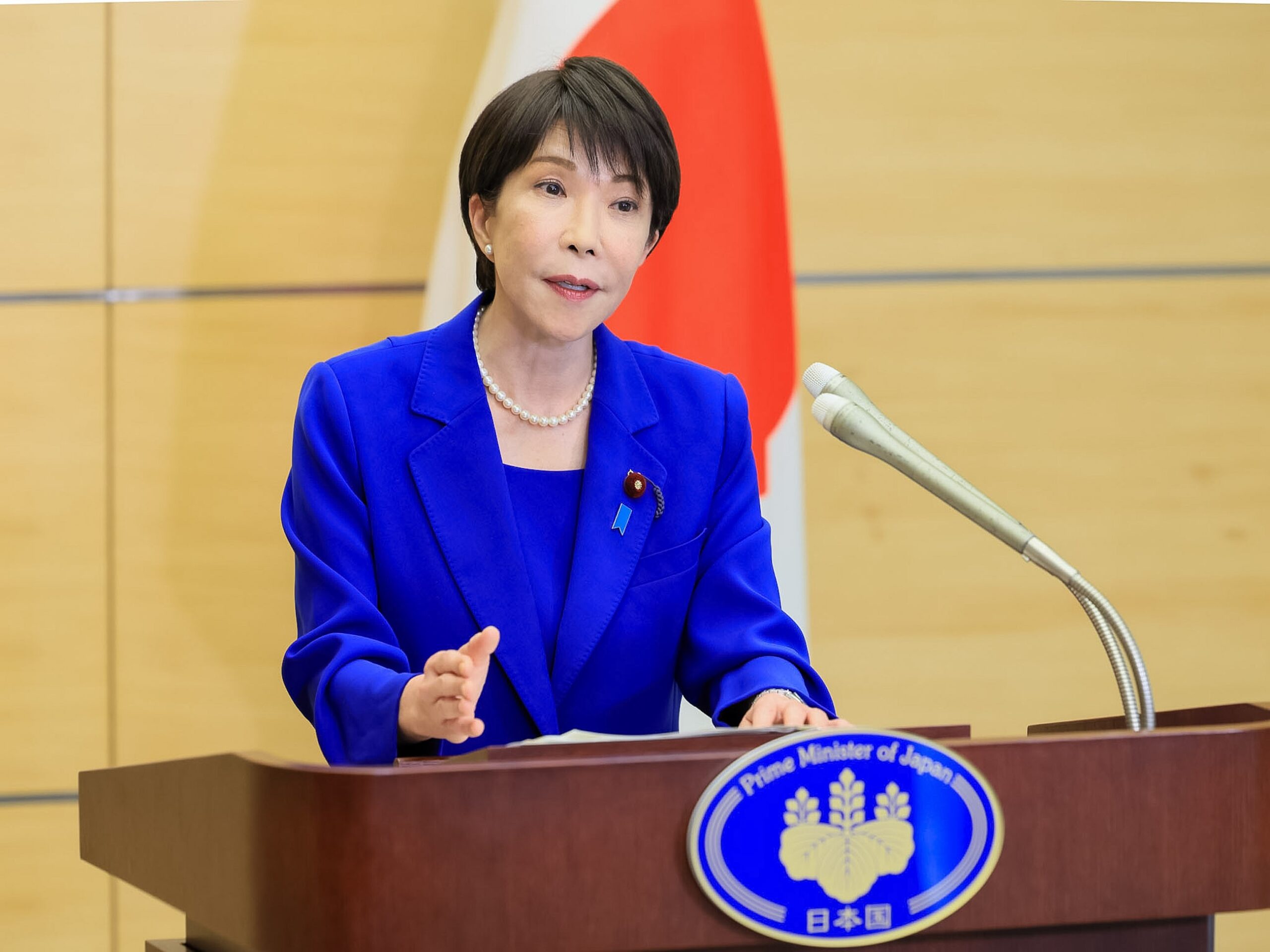
Key Points
・Prime Minister Sanae Takaichi’s cabinet took office on October 21, 2025. In its first year it passed a revision of the Imperial House Law and opened a National Intelligence Bureau, while Japan’s first consumption tax cut, on food, has reached the stage of a cabinet-approved bill and is not yet in force.
・During the same year the external environment shifted, with Chinese measures against Japan, a US, China and Russia summit floated by Moscow, and escalating protests in France. Japan widened its cooperation with middle powers such as Canada and Australia.
・As major powers cut deals among themselves, whether Japan can make its voice heard on decisions that affect it depends on funding those new channels and on public consent to their cost.
▼ Watch the Japanese-language video explainer
This video has Japanese audio and slides. To read English captions, open Settings → Subtitles/CC → Auto-translate → English, where available. Automatic translations may contain errors. If the option is unavailable in the embedded player, watch on YouTube. The accompanying English article provides the written explanation.
Takaichi Cabinet Marks One Year, with the Revised Imperial House Law Due to Take Effect on the 24th
Prime Minister Sanae Takaichi’s cabinet reached its first anniversary on October 21, 2026. It began in October 2025 when the Liberal Democratic Party (LDP) and the Japan Innovation Party (Ishin) agreed to a coalition, with Ishin supporting the government from outside the cabinet. In the February 8, 2026 lower house election, the LDP won 316 seats, enough to exceed two thirds of the chamber by itself. Ishin entered the cabinet for the first time in the reshuffle of September 17.
The revised Imperial House Law, enacted in July, is scheduled to take effect on October 24. On October 9, the government approved in cabinet a bill to cut the consumption tax on food to 1 percent for two years from April 2027. At an Upper House budget committee session on October 19, the prime minister said the cut could be funded through measures such as higher-than-expected tax revenue and returned fund balances, but did not rule out issuing government bonds, according to reports.
Agriculture minister Kazuo Yana, appointed in the reshuffle, resigned on October 14.
In the polls that followed, cabinet approval stood at 57 percent in the NNN and Yomiuri Shimbun survey of October 16 to 18, according to NNN, and at 49.1 percent in Kyodo News’ survey of October 17 to 18, according to Kumamoto Nichinichi Shimbun. It was the first time since the cabinet took office that approval fell below 50 percent in a Kyodo poll.
While Japan moved on domestic institutions, the behavior of the major powers around it also shifted. On October 19, Kremlin spokesman Dmitry Peskov said a three-way meeting of President Putin, President Trump and President Xi Jinping could take place on the sidelines of the Asia-Pacific Economic Cooperation (APEC) leaders’ meeting in China in November. He said no specific proposal or agreement had come from anyone, and that the agenda had not been discussed, according to Reuters.
Related Articles
Three Domestic Institutions, and a Changed Outside World
The Imperial House Law is the statute that sets the rules for the membership and succession of Japan’s Imperial Family. The revision was enacted on July 17, 2026 and promulgated on July 24. It takes effect three months after promulgation, on October 24, so it was still not in force as of this article, according to the House of Representatives. In the lower house, the LDP, the Centrist Reform Alliance, Ishin, the Democratic Party for the People and Sanseito voted in favor, and the Japanese Communist Party voted against.
The Imperial House Law revision rests on two pillars to keep the number of royals up
First, female members of the Imperial Family will keep their status after marrying men outside the family. Until now, a female member left the family when she married a commoner. Under the revision, female members at the time the law takes effect may still choose to leave on marriage, and husbands and children do not become members of the family.
Second, the law creates a system for adopting male-line men descended from the 11 branches of the family that left the Imperial Family after the war, if they are 15 or older and wish to be adopted. An adopted man does not gain a place in the line of succession. Article 1 of the law, which says the throne passes to male-line male descendants, is left as it was.
The National Intelligence Bureau opened in July
On July 31, 2026, a National Intelligence Council chaired by the prime minister and a National Intelligence Bureau directly under the Cabinet were established, according to the Cabinet Secretariat. Its role is to gather and analyze information that had been spread across ministries and feed it into government decisions. The head of the bureau was upgraded from the previous Cabinet Intelligence Director.
On security, the Defense Minister said at a November 28, 2025 press conference that the target set in 2022, defense and related spending equal to 2 percent of fiscal 2022 GDP by fiscal 2027, was expected to be reached early, in fiscal 2025, by combining the initial budget and the supplementary budget proposal. That is the minister’s estimate at the time, not a figure for actual spending.
Japan’s first consumption tax cut is not yet in force
The cut on food is planned for two years from April 2027, as a bridge until a new income-linked benefit begins. The bill has been approved by the cabinet and still has to pass the Diet. The earliest household impact would be April 2027.
For funding of about 10 trillion yen over two years, the government has said it will avoid special deficit-covering bonds. It points to a review of subsidies and special tax measures, the return of fund balances, and more non-tax revenue such as foreign exchange fund transfers. The prime minister repeated in her October 5 policy speech that funding would be secured without relying on special bonds.
Which source covers how much has not been decided, and the government says details will come in the year-end budget process. The tax revenue windfall cited in the October 19 answer is a yearly outcome that has been spent before, for example on supplementary budgets. Rising prices tend to lift nominal tax revenue, but the government’s official explanations have not gone as far as counting that increase as a source for the cut.
The outside world shifted during the same year
Japan’s relations with the major powers moved a great deal this year. With the United States, Japan has entered the stage of carrying out the $550 billion investment commitment agreed under the Ishiba government in September 2025. Two rounds by March 2026 settled projects worth about one fifth of the total, according to Kyodo News via the Akita Sakigake Shimpo. Projects are selected through a US committee and the US president.
With China, ties have chilled since November 2025, when the prime minister told the Diet that a Taiwan contingency could constitute a “survival-threatening situation,” a legal term that can allow Japan to use force in collective self-defense. China has layered on countermeasures, including a call to avoid travel to Japan, a halt to Japanese seafood imports, and tighter export controls on rare earths and other goods aimed at Japan from January 2026.
Chinese visitors to Japan in August were down about 60 percent from a year earlier. Kyodo News reported in May that no ministerial-level dialogue was taking place, and in October, when China widened the intake for a visiting Keidanren delegation, it again described government-to-government dialogue as stalled.
Against that background, Japan held summits with Canada in March, France in April, Australia in May and India in July, and signed documents centered on economic security with each. All four documents include broadening sources of critical minerals such as rare earths and concern about the use of export controls as economic coercion. With France, Japan also held a foreign and defense ministers’ meeting (2+2).
Powers deciding among themselves, and a shaky Europe
The three-way summit idea came from Russia. A US newspaper reported that Putin proposed a three-way meeting on how to end the war in Ukraine, without Ukraine in the room, and a senior US official said Trump has not agreed. No date has been set. Ukrainian Foreign Minister Andrii Sybiha criticized the idea as only helping Putin keep fighting.
Europe, the other pillar of the West alongside the United States, has its own domestic turbulence. In France, protests that started in September with school blockades merged in October with anger over prices and fuel costs. On October 17, about 550,000 people took part nationwide, according to the Interior Ministry. Some protests turned into arson and looting, and detentions reached about 2,400.
President Macron said in an October 18 address that he separated peaceful participants from those who use violence, and instructed the prime minister to support those affected and to consult parties and unions. A government without a majority in parliament faces a vote on next year’s budget in November while handling the unrest, leaving little room on spending. Britain changed prime ministers in July, and a minister in Germany’s coalition resigned in October.
In this setting the idea of the middle power has drawn attention. It refers to a country that is not a superpower but has influence through economic strength and diplomacy. In January, Canadian Prime Minister Mark Carney said at the World Economic Forum in Davos that middle powers can team up to build another path even as the major powers confront each other.
In March in Australia, Carney was reported to have said that the combined economies of Europe, Canada, Australia, Japan and South Korea exceed that of the United States, and he then traveled to Japan. There is still no formal framework that includes Japan.
Japan Has More Options, and the Test Is Sustaining Them
A year of moving institutions at home
In one year the Takaichi government passed the Imperial House Law revision with support from most parties in the Diet, opened the National Intelligence Bureau, and turned Japan’s first consumption tax cut into a bill. Cabinet approval has stayed between roughly 50 and nearly 60 percent depending on the poll, and with the February landslide the government keeps the footing to push policy.
Difficulties are visible too. The food tax cut is at the stage of listing funding candidates, with the question of how much comes from where pushed to the year end, and rising interest rates swell the cost of servicing government debt. In next year’s budget requests, the interest rate used to estimate debt servicing costs has been raised to 3.8 percent. On the agriculture minister’s resignation, a majority in Kyodo’s poll said the response was too slow.
Holding a majority in the Diet and winning the public’s consent, including to costs and downsides, are different strengths. The broad agreement shown on the Imperial House Law is the kind that would have to be built again for a tax cut that comes with a funding burden, or for foreign policy. That is the second-year challenge.
Expectations arrive from outside, while achievements are built at home
A year that kept the home base intact was also a year in which Japan was named more often as one of the middle powers to partner with. The Canadian prime minister’s tour and a scholar’s call for Asia-facing diplomacy are examples. Most of that came as expectation from outside, created by shifts in US behavior and by European turbulence, which is a different source from what the government itself has achieved.
Even the turbulence in Europe differs by country. What is happening in France is a domestic political and fiscal problem, where street protests overlap with parliamentary budget talks. In markets, the gap between French and German government bond yields has widened again, showing wariness about French public finances.
Concern about the cost of living is not limited to France, and Macron himself said it exists in other European capitals. If the turbulence drags on, it could affect the capacity Europe can direct outward.
In March, a commentary by the think tank Friends of Europe said that after the lower house landslide Europe can no longer take Japan’s predictability for granted. The same commentary also recognizes Japan’s weight as an alternative supplier in supply chains. Expectation and wariness sit side by side in the same text.
On the outward side, what the government has built is the documents with four countries and the opening of the National Intelligence Bureau. The content of the four documents is mostly about critical minerals and preparing for economic coercion, which also means Japan moved out of its own need after China’s measures. A long distance remains between signing and the point where sources of supply actually grow and Japan can withstand pressure.
Partnerships outside the alliance do not replace the United States
Calls for middle powers to unite are usually met with a question about where military strength comes from. The base of Japan’s security is the Japan-US alliance, and the partnerships with Australia, France, Canada and India sit alongside it as reinforcement, adding sources of supply, technology and friends in international forums.
On the alliance side, Japan has been taking on costs. Under the US investment commitment, projects are selected by the US president, and defense spending has been raised ahead of schedule.
From a pro-alliance position, Kenneth Weinstein of the Hudson Institute is among those who give high marks to the stronger defense spending and intelligence capability. On the other side, South Korea’s Kyunghyang Shinmun described the year as one from excitement to disappointment, saying the Taiwan remarks froze Japan-China relations and that fewer tourists became an economic loss.
The three-way summit idea is at a stage with no concrete proposal or agenda. The interests of the United States, China and Russia clash in many places, so it may not take shape quickly. Even so, the mere report of a plan to discuss how to end the war without Ukraine raised fears that things might be decided over the heads of the countries concerned. In a world where major powers cut deals, for Japan or other middle powers to take part in decisions that affect them, what matters is whether they have a channel to deliver their views before and after those talks.
On the question of available options, China moved in the opposite direction. Between a China that wants Japan to correct its remarks and a Japan that has not withdrawn them, government-to-government dialogue is reported to be stalled. The November APEC meeting is hosted by that same China. To reach a venue where the major powers gather, a channel for dialogue with China is one more tool, alongside influence inside the alliance.
What sustains the tools is funding, people and consent
Widening partnerships beyond the alliance, raising defense spending and cutting the consumption tax are all things that need money and public support to continue. If public consent thins, commitments made abroad become harder to keep.
Sustaining them also takes people and the ability to build. Even with more defense money, the budget does not become capability unless equipment can be made and personnel recruited. A document on widening sources of critical minerals turns into a supply chain only when the industries that refine and process them grow.
The burden of China’s countermeasures falls on daily life, in tourist areas and the seafood industry. The cost of diplomatic choices is paid from household and local budgets.
Japanese Reactions to the Takaichi Government’s First Year
This section covers posts on X. They are reactions on X, not a measure of Japanese public opinion. We looked at a newspaper’s report post, a commentary shared by a news outlet, a widely shared individual post that backs the government, and an individual post that criticizes it.
The first post is from Nikkei, which framed the year around two relationships: close contact with the United States and a chill with China.
高市政権1年、日中関係冷え込み アメリカとは円安対応で足並みhttps://t.co/NSNuPJLR9S
— 日本経済新聞 電子版(日経電子版) (@nikkei) October 21, 2026
高市首相はトランプ氏と電話を含め9回協議。「最近は何を言っても怒らない」と関係構築の手応えを語ったことも。対して中国とは、習近平国家主席と一度会談しただけです。
“Takaichi government at one year: Japan-China relations chilled, in step with the US on the yen response. Prime Minister Takaichi has held talks with Trump nine times, including by phone. She also said she feels she is building the relationship, noting ‘Recently he doesn’t get angry whatever I say.’ By contrast, she has met China’s President Xi Jinping only once.”
Nikkei (Nikkei Electronic Edition), October 21, 2026 (translation of the post text)
The post puts the relationship with the United States and the one with China side by side, which matches the shape of this article’s argument. The next post is a comment shared by Asahi Shimbun’s Comment Plus, from Katsuhiro Yoneshige, the CEO of JX Press, a news agency. The post text is cut off partway, so we translate only the part shown.
JX通信社代表取締役の米重克洋さんがコメントしました。
— 朝日新聞コメントプラス💬ニュースを読み解く視点をプラス! (@asahi_comment) October 21, 2026
【視点】「高市さんに好感を持つ有権者と自民党に好感を持つ有権者は、必ずしも一致しない」という点はその通りで、ネット上の言説でも同様の傾…
高市政権1年、「自民支持と必ずしも一致しない」 推す有権者の姿はhttps://t.co/5rzbQjakOw
“Katsuhiro Yoneshige, CEO of JX Press, commented. [View] ‘Voters who feel warmly toward Takaichi and voters who feel warmly toward the LDP do not necessarily overlap.’ That is indeed true, and the same tendency in online discourse…” (the post text is cut off here)
Asahi Shimbun Comment Plus, October 21, 2026 (translation of the post text)
That fits the polling picture above. High approval of the person and the party’s own standing are separate things. The last post comes from an individual account that supports the government and was widely shared. It celebrated the anniversary with a list of figures.
【祝・高市政権1年🎂】数字で黙らせた1年、反省点まで有能だった件
— まみ🫶やさしめ保守 (@mamichan_jpn) October 21, 2026
きょう官邸で記者団にコメント
📈 1年の成果、数字がエグい
✓株価 4万円台→6.5万円超え
✓税収 84.2兆円で過去最高
✓賃上げ率 3年連続5%超え
✓名目GDP 700兆円が射程圏
✓政府提出法案74本、全部成立… pic.twitter.com/0YqAi717vi
“[Congratulations on one year of the Takaichi government] A year that silenced critics with numbers, with even the reflections competent. Today the prime minister commented to reporters at the Kantei. A year of results, the numbers are huge. Stock prices: from the 40,000s to above 65,000. Tax revenue: a record 84.2 trillion yen. Wage increases: above 5 percent for the third year in a row. Nominal GDP: 700 trillion yen within reach. Bills submitted by the government: 74, all enacted.”
mamichan_jpn (individual account), October 21, 2026 (translation of the post text; the figures are the poster’s claims, which we have not verified)
The poster’s figures are claims in a celebratory post and not findings of this article. A critical post from another individual account looked at the same year from the opposite side.
高市政権1年 豊かさが実感できない
— 星見おじさん (@set_ten) October 21, 2026
国内に目を向けると円安、原油高に起因する物価高と重税で生活は苦しくなる一方
経済は低迷してGDPは既に6位付近、個人だと37位
海外に目を向けると、近隣国との摩擦で孤立
外交も経済も展望が見えず、国民の暮らしの豊かさより富国強兵に走る日本#改憲反対 https://t.co/DI1difVWgA
“Takaichi government at one year: we cannot feel any richer. At home, prices driven by the weak yen and high oil prices, plus heavy taxes, keep making life harder. The economy is sluggish, with GDP already around sixth in the world and 37th per person. Abroad, friction with neighboring countries is isolating us. With no outlook for either diplomacy or the economy, Japan is pursuing a rich country and a strong military rather than the prosperity of people’s lives. #AgainstConstitutionalRevision”
Hoshimi Ojisan (@set_ten, individual account), October 21, 2026 (translation of the post text; the rankings are the poster’s claims, which we have not verified)
The two individual posts list results and burdens for the same year, and they barely overlap: one counts stock prices, tax revenue and enacted bills, the other counts prices, taxes and strained ties with neighbors. The critical post’s phrase about not feeling richer echoes the anniversary editorials shared on X. Because this rests on a handful of posts, it cannot show proportions.
Domestic Policy and Diplomacy Are Not Graded Separately
What it takes to remain a country with choices
In its first year, the Takaichi government moved Japan’s institutions, revising the Imperial House Law and opening the National Intelligence Bureau. The first consumption tax cut has funding candidates but no decided amounts, and remains before implementation. Abroad, as relations with the major powers shifted, documents with countries outside the alliance widened Japan’s channels of cooperation and its options.
Whether Japan, as one of the middle powers, can turn those wider channels into the strength to withstand pressure and to make its voice heard in decisions by major powers belongs to the second year and beyond. More than the size of expectations from outside, what is tested is whether Japan can keep up the tools it now has. The foundations are the soundness of funding, the people and industries that run equipment and supply chains, and public consent that comes with knowing what the burdens are.
The grade for daily life and the grade for diplomacy rest on the same wallet, the same workers and the same voters. What the second year tests is less what new thing the government announces than whether it can show who pays for the tools gained in the first year, and how.
Frequently Asked Questions
What did the Takaichi government accomplish in its first year?
It revised the Imperial House Law, enacted on July 17, 2026 and scheduled to take effect on October 24, and it opened the National Intelligence Bureau on July 31, according to the House of Representatives and the Cabinet Secretariat. It also won the February 8, 2026 lower house election with 316 LDP seats. Its first consumption tax cut, on food, is a bill approved by the cabinet on October 9 and is not yet in force.
Is the cabinet’s approval rating falling?
It depends on the poll. The NNN and Yomiuri Shimbun survey of October 16 to 18 found 57 percent, while Kyodo News’ survey of October 17 to 18 found 49.1 percent, according to each outlet. The first fall below 50 percent applies only to Kyodo’s poll, so the two figures are shown separately and not averaged.
Will the consumption tax on food really fall to 1 percent?
It is planned but not yet decided in law. According to the government’s October 9 cabinet approval, the rate would drop from 8 percent to 1 percent for two years from April 2027, which requires the bill to pass the Diet. Funding of about 10 trillion yen over two years has candidates, such as subsidy reviews and returned fund balances, but how much comes from each source has not been decided.
What is a middle power, and why does it matter to Japan now?
A middle power is a country that is not a superpower but has influence through economic strength and diplomacy. Canadian Prime Minister Mark Carney said at the World Economic Forum in January 2026 that middle powers can team up to build another path as major powers confront each other. Japan signed economic security documents with Canada, France, Australia and India during the year, though there is no formal framework of middle powers that includes Japan.
How did Japanese social media react to the Takaichi government’s first year?
On X, the posts we examined included a Nikkei report on the contrast between close ties with the United States and a chill with China, a commentary noting that liking Takaichi and liking the LDP are not the same, a widely shared supporter’s post listing figures such as stock prices and tax revenue, and a critic’s post saying people cannot feel richer amid high prices, heavy taxes and friction with neighbors. This is a small selection of posts and not a measure of Japanese public opinion.
Sekahan on YouTube
We publish video summaries of articles like this one, along with short clips built around Japanese reactions.
Reference Links
- Prime Ministers of Japan, the 104th: Sanae Takaichi (Japanese) | Prime Minister’s Office of Japan
- 2026 lower house election: LDP wins historic landslide and secures two thirds (Japanese) | nippon.com
- Press conference on the change of agriculture minister (Japanese) | Prime Minister’s Office of Japan
- Takaichi cabinet approval at 57 percent, little changed (NNN and Yomiuri poll, Japanese) | NNN
- Progress of the bill to partially amend the Imperial House Law (Japanese) | House of Representatives
- National Intelligence Council and National Intelligence Bureau (Japanese) | Cabinet Secretariat
- Defense Minister’s press conference, November 28, 2025 (Japanese) | Ministry of Defense of Japan
- Japan-Australia summit meeting and signing ceremony (Japanese) | Ministry of Foreign Affairs of Japan
- Takaichi says tax cut funding is “manageable,” citing foreign exchange fund and revenue windfalls (Japanese) | Newsweek Japan (Reuters)
- Kremlin says Putin, Trump and Xi could hold a three-way meeting in China next month | Reuters via AOL
- The Takaichi mandate: why Europe can no longer take Japan’s predictability for granted | Friends of Europe