Key Points
・Myanmar military airstrikes on November 26 and 28, 2026 hit areas near a school and monastery, a wedding venue and a market, and reports say many people, including children, were killed.
・In a country where the army wrote its power into the constitution, the 2021 coup added an armed pro-democracy uprising to a much older war with ethnic armed groups.
・The anti-military side does not share one plan and ceasefires stay local, so an army that has lost ground is leaning more on attacks from the air.
▼ Watch the Japanese-language video explainer
This video has Japanese audio and slides. To read English captions, open Settings → Subtitles/CC → Auto-translate → English, where available. Automatic translations may contain errors. If the option is unavailable in the embedded player, watch on YouTube. The accompanying English article provides the written explanation.
Myanmar Military Airstrikes Kill Dozens at a School Area and a Wedding
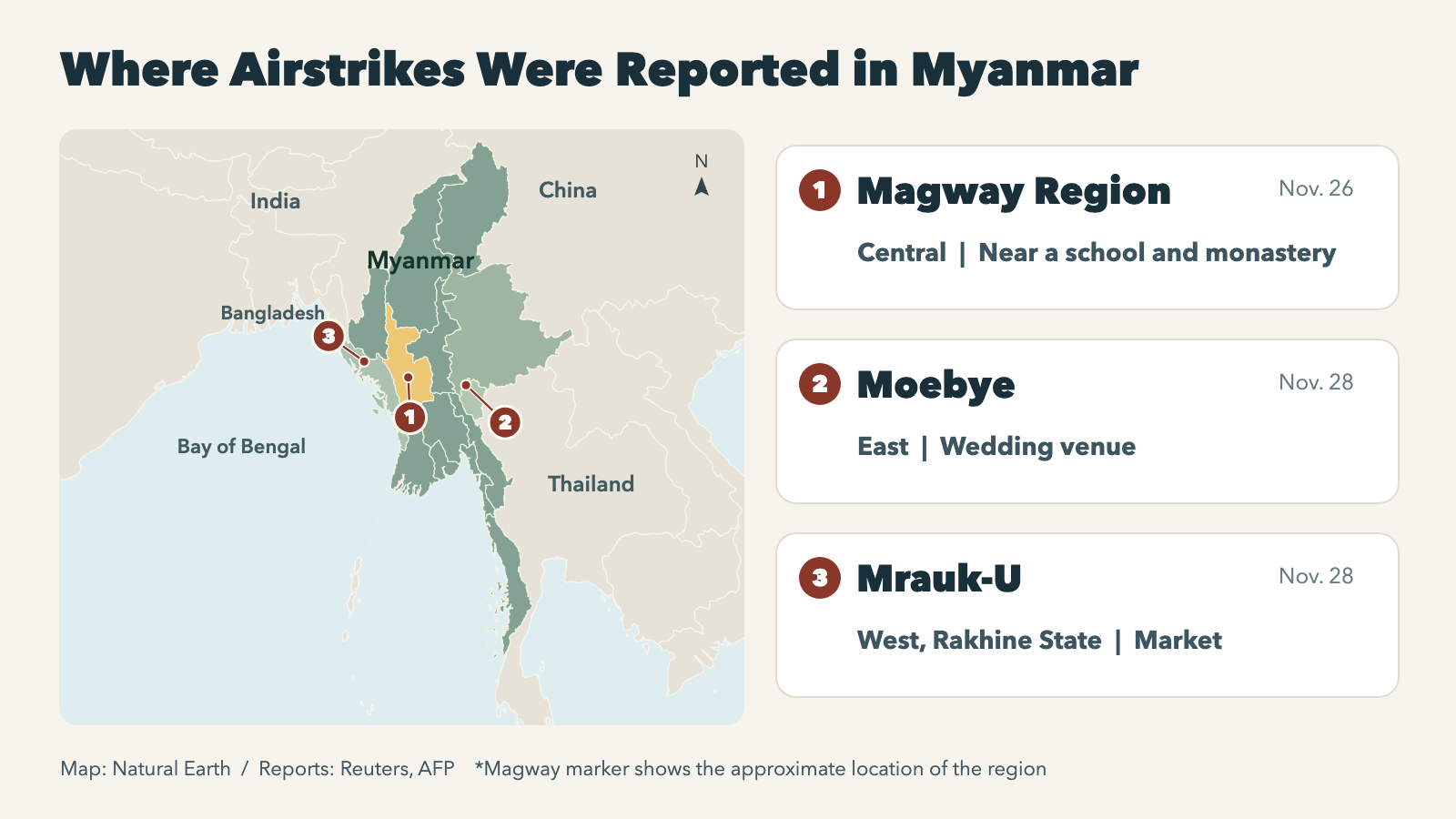
On the afternoon of November 26, Myanmar’s military carried out an airstrike near a school and a Buddhist monastery in a village in Sinbaungwe Township, Magway Region, in central Myanmar, while a religious festival was taking place. Reuters reported that at least 30 people, including babies and schoolchildren, were killed, citing witnesses and the National Unity Government (NUG), a government formed by pro-democracy politicians after the 2021 coup that opposes the military. According to the NUG, the dead from the air and artillery strikes included more than 20 civilians and nine resistance fighters.
On November 28, an airstrike hit a wedding of displaced people in Moebye, near the border between Shan and Karenni (Kayah) states. A local aid group told AFP it had confirmed 21 deaths, including five children, and more than 40 injuries. In Mrauk-U, in western Rakhine State, an airstrike hit a market, and a local funeral group said nine people were killed.
The military has not issued an official statement on the Magway strike. Pro-military social media channels claimed the attack was based on information that resistance fighters were holding a ceremony after training. These are claims by pro-military channels, not a statement from the military, and they have not been independently verified. AFP said it could not reach the military for comment on the November 28 strikes.
The strikes came days after the International Court of Justice (ICJ) ruled on November 19 that Myanmar had violated the Genocide Convention over the 2017 persecution of the Rohingya, a mostly Muslim minority. No link between the ruling and these strikes has been confirmed. The NUG has asked the United Nations, the Association of Southeast Asian Nations (ASEAN) and neighboring countries to stop aviation fuel and ammunition from reaching the military.
Related Articles
Who Is Fighting, and How the Army Kept Its Power
The Tatmadaw is the name of Myanmar’s armed forces, which have stood at the center of the country’s politics for more than 60 years. Today they fight two kinds of opponents at once: ethnic armed groups that have sought self-rule for decades, and pro-democracy fighters who took up arms after the 2021 coup.
An army that ran the country for decades
In 1962, General Ne Win led a coup, and the military ruled for the next 26 years. Military-led rule continued after that. In 2008, the junta wrote the current constitution, and in 2011 the country moved to civilian rule, at least on paper.
According to the 2008 constitution, the army keeps real power even when it loses an election. A quarter of the seats in both houses of parliament go to soldiers named by the commander-in-chief, with no vote. The three ministers in charge of security, for defense, home affairs and border affairs, are also soldiers chosen by the commander-in-chief.
Changing the key parts of the constitution needs more than 75 percent of lawmakers plus a national referendum. Because soldiers hold a quarter of the seats, the army can block any such change.
Election wins, then the 2021 coup
In the 2015 election, the National League for Democracy (NLD), led by Aung San Suu Kyi, won a large majority. A clause in the constitution bars people with foreign family members from becoming president, so Suu Kyi led the government through a new post called “State Counsellor.”
This uneasy sharing of power lasted a little over five years. After the NLD won again in the 2020 election, the military claimed there had been fraud. On February 1, 2021, under Commander-in-Chief Min Aung Hlaing, it staged a coup and detained Suu Kyi and other leaders.
The military said in a February 2021 statement that the voter lists contained about 10.48 million errors that amounted to fraud, and that it took power under the constitution’s state-of-emergency clauses. Errors in a voter list, however, do not show that the same number of fraudulent votes were cast. The Asian Network for Free Elections (ANFREL), a regional election-monitoring group, found the military’s claims unsupported and said the result broadly reflected the will of voters.
When the army crushed nationwide protests with force, pro-democracy leaders set up the National Unity Government and formed armed groups called People’s Defence Forces (PDFs) across the country. Part of a peaceful protest movement became an armed resistance.
Between December 2025 and January 2026, the military held a general election, and a military-backed party won by a wide margin. Min Aung Hlaing moved from commander-in-chief to president and took office in April 2026. International election observers and other groups have criticized the vote as unfair.
An old civil war, and a new resistance on top of it
Myanmar’s largest group is the Bamar (Burman) majority, but the country is also home to many other peoples, including the Kachin, Karen, Shan and Rakhine. Since independence from Britain in 1948, ethnic armed groups seeking self-rule and rights have fought the army.
After 2021, a new armed resistance led by pro-democracy fighters joined this old war, and it grew in the central lowlands, where most people are Bamar. Magway, where the November 26 strike happened, was never a stronghold of ethnic armed groups. It is an area the NUG says it controls.
The war shifted sharply in October 2023. Three ethnic armed groups in the northeast launched an offensive called Operation 1027, and the army lost town after town near the Chinese border. In August 2024, resistance forces even captured the regional military command in Lashio, a key city in the northeast. After a ceasefire brokered by China, Lashio was handed back to the military in April 2025.
Civilian deaths from airstrikes were already rising
Records compiled by the UN Human Rights Office (OHCHR) show that civilians killed in airstrikes rose from at least 641 in 2024 to 982 in 2025. These are confirmed deaths, not the number of strikes.
A report by the UN High Commissioner for Human Rights said that, through May 2026, the army filled its ranks with forced conscription, carried out more airstrikes on areas where civilians live, and took back some territory. According to the same report, airstrikes counted from public information rose by almost 20 percent in the year from June 2025 compared with the year before, and 3.6 million people are displaced inside the country.
The same UN report says that in western Rakhine State, the military has lost 14 of 17 townships to the Arakan Army (AA), an ethnic armed group. According to an analysis by the conflict monitor ACLED, the army began a combined air and ground offensive there in September 2026 but has not yet retaken much territory.
The Rohingya ruling and how other countries responded
The ICJ ruling on November 19 came in a case The Gambia brought against Myanmar. The court found that the persecution of the Rohingya in the 2017 “clearance operations” amounted to genocide. This is a case about the responsibility of a state, not a criminal trial of individuals, and it does not cover the recent airstrikes.
In August 2017, the Arakan Rohingya Salvation Army (ARSA), a Rohingya armed group, attacked police posts and other sites, and Myanmar has argued that the army’s operation was a response to terrorism. The judgment accepted that the attacks and the operation were linked in time and place, and said that fighting an armed group and intending genocide can exist side by side. It then rejected Myanmar’s explanation, finding that acts such as targeting babies and children, sexual violence and attacks on civilians could not be explained by operations against an armed group alone.
After the ruling, the United Kingdom announced on November 23 sanctions on five senior military officials and said it intends to pass a law to help stop aviation fuel from reaching the military.
ASEAN agreed a “Five-Point Consensus” after the coup, calling for an end to violence and for dialogue, and has not allowed the military’s leaders to attend its summits as full representatives. At its summit in Manila on November 15, ASEAN decided to keep these limits for now and to restore Myanmar’s role step by step if there is progress under the consensus.
In 1989, the military government at the time changed the country’s English name from “Burma” to “Myanmar.” Some people and news organizations still use “Burma” because they do not accept the legitimacy of military rule.
Why the War Goes On and Turned to the Air
Why don’t the groups fighting the army act as one?
The groups fighting the military agree that they oppose it, but their priorities differ. Many ethnic armed groups have sought self-rule and rights for their own regions for decades. The NUG calls for a federal democratic state and works with some ethnic armed groups, but each group runs its own chain of command.
For groups that already govern large areas, protecting their own territory can matter as much as changing the national government, or more. Each group, in each region, makes its own call on whether to fight or to agree to a ceasefire.
This shows in the ceasefires. With China as the broker, the army agreed a ceasefire in January 2025 with the MNDAA, an armed group of the Kokang people in northern Shan State. In April, Lashio returned to the army under Chinese ceasefire monitors. In October, the army also agreed a ceasefire with the TNLA, an armed group of the Ta’ang people in the same northeastern area.
Both deals apply only to specific areas. Fighting continues in Rakhine in the west and against pro-democracy forces in the center. In places with a ceasefire, fighting stops and daily life can return. But if the army moves troops from those fronts to other places, more local ceasefires will not add up to an end to fighting across the country.
Why has the army turned to airstrikes?
Since Operation 1027, the army has lost many positions on the ground. Even with forced conscription, it struggles to hold back armed groups in many regions at the same time.
That is why attacks by fighter jets and drones have become more important. Most resistance groups have no aircraft and few ways to defend against attacks from the air. For the army, airstrikes are a way to hit areas held by its opponents without risking its own soldiers.
But the bombs fall where people who live under resistance control go about their lives. In Magway, pro-military channels claimed the target was a gathering of resistance fighters, yet many people, including children, died near a school and a monastery.
Through airstrikes and conscription, the army has also regained some areas. Still, as long as attacks keep killing civilians, people will trust any deal with the army less. The more the army relies on airstrikes, the harder it may become to govern and reconcile after any ceasefire.
Why does each outside power act differently?
The countries involved in Myanmar’s war each want different things, and they should not be seen as one bloc.
China cares most about a stable border and its economic interests. Kyaukphyu, on the western coast, is the starting point of oil and gas pipelines that run to China’s Yunnan Province, and there are plans for a port under China’s Belt and Road Initiative. China keeps ties with the military while brokering ceasefires with armed groups near its border.
Russia is one of the countries that has supplied the military with weapons. According to a May 2023 report by the UN Special Rapporteur, the military imported at least 1 billion dollars’ worth of weapons and materials from the coup to the end of 2022. The same report put Russia as the largest source, at more than 400 million dollars, followed by China at 260 million dollars.
The United States has kept its sanctions on Min Aung Hlaing. Reuters reported that Washington has drawn up a strategy that aims for a ceasefire and a path to a peace agreement by 2030. That strategy also covers cracking down on scam centers in border areas and access to rare earths in conflict zones.
Countries are also divided on how to treat the government of Min Aung Hlaing, who became president after the election. The UN High Commissioner for Human Rights has urged countries not to give the military political legitimacy.
ASEAN keeps limits on Myanmar’s role at its summits, and the United Kingdom has added sanctions on military leaders and a planned law on aviation fuel. China and Russia keep their ties with the military. Outside pressure has helped produce local ceasefires, but it has not yet led to a nationwide halt in fighting or fewer airstrikes.
Japanese Reactions to the Myanmar Airstrikes
These are five posts on X from individual users in Japan, written on November 28 and 29 as Japanese media reported the strikes. They are a small selection found by search, not a measure of Japanese public opinion. Claims in the posts are the posters’ own views.
本当は行く予定だったミャンマー
— 便意カンスト (@Benicnst) November 29, 2026
パンデミックが発生して
行けなくなっちゃったけど
いつか行きたいとずっと考えてる
けども…全然状況よくならないし
スーチーさんは閉じ込められたまま
選挙やって新政権がはじまり
それでも誰も納得はしてないみたい
内戦が終わりそうにない https://t.co/kT5S8rZvxy
I was actually planning to go to Myanmar,
but then the pandemic hit
and I couldn’t go.
I’ve always thought I’d like to go someday.
But… things aren’t getting any better at all,
Ms. Suu Kyi is still locked up,
they held an election and a new government started,
and it seems no one is convinced even so.
The civil war doesn’t look like it will end.
ミャンマー軍、結婚式会場や学校を相次ぎ空爆 民間人多数死亡(毎日新聞)#Yahooニュース
— 角を矯めて牛を殺す三白眼😁😎 (@erotici49484373) November 29, 2026
中国はインド洋に伸びるパイプラインがミャンマーを通っている為?
民主化を嫌う中国は国軍の支援を止める気配はありません…😱https://t.co/cQpdjGyHD4
Myanmar military launches a string of airstrikes on wedding venues and schools; many civilians killed (Mainichi Shimbun) #YahooNews
Is it because the pipeline China runs to the Indian Ocean passes through Myanmar?
China, which dislikes democratization, shows no sign of stopping its support for the military…😱
ミャンマー軍の非道な行為にどうして世界の国々は無視できるんだ!
— Jiroさん (@Jiro3263) November 29, 2026
軍のクーデターが起きてから、罪の無い人々がしょっちゅう殺害されている!
なんで世界はミャンマーに無関心でいられるんだ?
アメリカやNATOならすぐ悪の軍事政権を倒せるだろ? https://t.co/wD89mVMESE
How can the countries of the world ignore the Myanmar military’s atrocities!
Ever since the military’s coup, innocent people have been killed again and again!
Why can the world stay so indifferent to Myanmar?
Couldn’t the US or NATO bring down the evil military regime in no time?
今自分の配下には10人を超えるミャンマーの方がいる。うーん。
— NORENMUZIC (@higeeCHANg) November 29, 2026
ミャンマー軍相次ぎ空爆 内戦激化 2026年11月29日 https://t.co/pcZjXzaVs7
Right now I have more than 10 people from Myanmar working under me. Hmm.
Myanmar military’s successive airstrikes, civil war intensifies, November 29, 2026
だからといって易々と難民としてミャンマー人を受け入れるのは違うからね。
— Bookkeeper (@ReclaimJapan1) November 29, 2026
ミャンマー軍相次ぎ空爆 内戦激化https://t.co/jlXeWUdqeq
Even so, that doesn’t mean we should readily accept people from Myanmar as refugees.
Myanmar military’s successive airstrikes, civil war intensifies
What Comes After the Airstrikes
Can local ceasefires grow into national peace?
Myanmar’s civil war widened because, in a country where the army wrote its power into the constitution, the 2021 coup added a pro-democracy uprising to an old war with ethnic armed groups. It drags on because the groups fighting the army want different things and decide separately, and ceasefires are made region by region while fighting continues elsewhere.
The army, for its part, keeps fighting by conscripting soldiers, obtaining weapons and fuel from abroad, and attacking from the air.
The more an army that has lost ground relies on airstrikes, the more the harm falls on schools, monasteries, wedding venues and markets where people live their lives. The strikes in late November happened along that path.
Will China’s local ceasefires grow into national talks, or only give the army time to move its troops? Will civilian deaths from airstrikes fall, and will aid reach the 3.6 million people forced from their homes? The ICJ ruling and other countries’ sanctions are among the factors that may shape those answers.
Frequently Asked Questions
Why is there a civil war in Myanmar?
Myanmar’s civil war began soon after independence in 1948, when ethnic armed groups started fighting the army for self-rule. After the military’s coup on February 1, 2021, pro-democracy groups also took up arms, so the army now fights both at once.
Why is Myanmar’s military using more airstrikes?
Since an offensive by ethnic armed groups in October 2023, the army has lost many positions on the ground. The UN High Commissioner for Human Rights’ August 2026 report says it has carried out more airstrikes on areas where civilians live and used forced conscription, and has retaken some areas. Most resistance groups have no aircraft and little air defense, so airstrikes let the army hit their areas without risking its own soldiers.
What did the ICJ rule about Myanmar in November 2026?
On November 19, 2026, the International Court of Justice ruled in The Gambia’s case that Myanmar violated the Genocide Convention over the 2017 persecution of the Rohingya. The ruling concerns the responsibility of the state, not the criminal guilt of individuals, and it does not cover the recent airstrikes.
How did people in Japan react to the Myanmar airstrikes on social media?
On X, individual users in Japan shared reports from outlets such as the Mainichi Shimbun on November 28 and 29 with short comments. They expressed frustration that the war shows no sign of ending, questions about China’s role, anger at the world’s indifference, and views on Myanmar workers and refugees in Japan. This is a small selection found by search, not Japanese public opinion.
Sekahan on YouTube
We publish video summaries of articles like this one, along with short clips built around Japanese reactions.
Reference Links
- Myanmar military airstrike on village school kills at least 30 people, opposition says | Reuters via KFGO
- Myanmar junta airstrike kills at least 18, including schoolchildren, in Magway Region | Myanmar Now
- Airstrikes on wedding venue, other sites kill at least 30 in Myanmar | AFP via CP24
- Myanmar: Annual update, overview of developments in 2025 | UN Human Rights Office (OHCHR)
- Situation of human rights in Myanmar (A/HRC/63/21) | UN High Commissioner for Human Rights
- ICJ: The Gambia v. Myanmar | Independent Investigative Mechanism for Myanmar (IIMM)
- UK leads global action with major new measures against Myanmar military following landmark genocide judgment | UK Government
- ASEAN keeps Myanmar restrictions but opens the path to political return | Reuters via The Star
- US strategy links Myanmar peace talks to rare-earth access | Reuters via Devdiscourse
- Myanmar Constitution (2008, rev. 2015) | Constitute Project